Trust Root Configuration (TRC)
The Trust Root Configuration (TRC) is a signed collection of X.509 v3 certificates and ISD policy information that establishes the trust anchors of an ISD. It contains the CP Root Certificates that root the verification path for CP AS Certificates, together with the Sensitive Voting Certificates and Regular Voting Certificates and the policy used to vote on the next TRC.
The TRC payload is a SCION-defined ASN.1 structure, signed with CMS [RFC5652]. The certificates it carries follow [RFC5280] and [X509] with more restrictive SCION constraints. The SCION PKI draft defines the ASN.1 module, fields, signing, updates and certification paths.
TRC Format
The TRC payload is a DER-encoded container holding the ISD’s policy fields and the
set of self-signed certificates that anchor trust for the ISD. Its iD
identifies the ISD and the TRC’s base and serial numbers.
A TRC whose base number equals its serial number is a base TRC. The initial TRC has base number 1 and serial number 1. A trust reset starts a new update chain. Its base number should be one more than the serial number of the last TRC produced by a non-compromised update. Table 6 shows an example.
The validity and gracePeriod fields govern when the TRC can be used and
how long its predecessor may remain active. The noTrustReset field controls
whether the ISD permits a trust reset, while description describes the ISD.
The remaining fields identify the parties that operate and update the ISD’s trust infrastructure:
coreASeslists the ASes in the ISD core, which initiate path discovery.authoritativeASeslists the core ASes that keep the latest TRC and start announcing TRC updates. Every authoritative AS is also a core AS.certificatesholds the self-signed CP Root Certificates and the Regular and Sensitive Voting Certificates. The root certificates anchor the certificate chains for CP ASes. The voting certificates identify the voters authorized to sign TRC updates; a voter need not be a core AS or even have an AS number.votingQuorumspecifies how many votes are required for an update.votesidentifies the voting certificates in the predecessor TRC whose holders signed this TRC; it is empty in a base TRC.
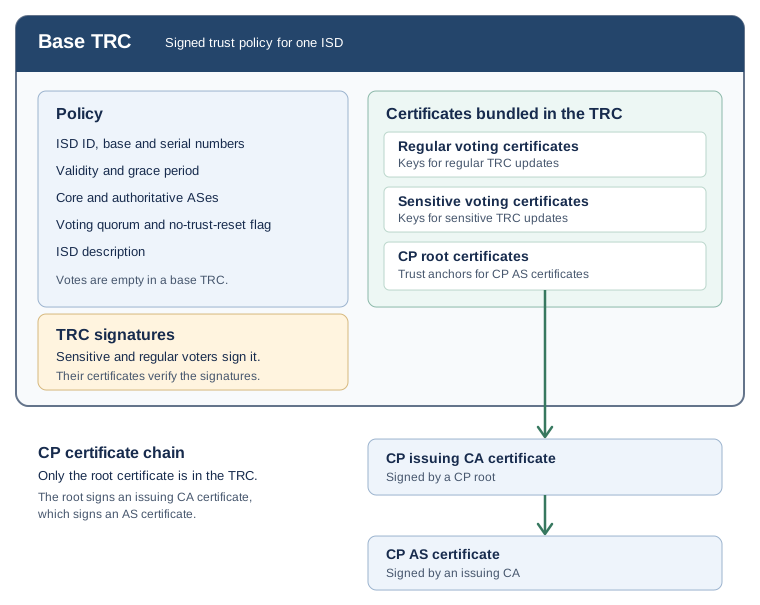
A base TRC and its certificate hierarchy, simplified from Figure 2 of the SCION PKI draft.
The field definitions and certificate-set constraints are specified in TRC Fields, and the ASN.1 module in TRC in ASN.1 Syntax.
Signed TRC Format
The TRC payload is signed as a CMS SignedData content and encapsulated in a CMS
ContentInfo, following [RFC5652] with SCION-specific restrictions (an empty
certificates field, id-data content type, and IssuerAndSerialNumber
signer identifiers). The exact CMS profile is specified in TRC Signature Syntax.
In the open-source SCION implementation,
each SignerInfo also carries signed attributes with a message-digest attribute
([RFC5652], Section 11.2) computed over the DER-encoded TRC payload.
TRC Update
A regular update keeps the voting quorum, the core ASes, the authoritative ASes,
the number and distinguished names of all root and voting certificates,
and the set of Sensitive Voting Certificates. It may replace Regular
Voting Certificates and CP Root Certificates. Each replaced regular voting
certificate must vote, and each replaced root certificate must sign.
All votes come from Regular Voting Certificates. Every other update is a
sensitive update, and all its votes come from Sensitive Voting Certificates.
No update changes the ISD, the base number or noTrustReset.
Every update increments the serial number by one.
The update rules and verification algorithm are specified in TRC Updates.
Both voting certificate types are self-signed end-entity certificates. Their recommended maximum validity period is 5 years. Voting Certificates describes their role. X.509 Certificate Profiles and Constraints and Extensions specify their profile.
TRC Equality
The signer information in a signed TRC is an unordered set ([RFC5652]) and can be reordered without affecting verification. Two signed copies of one TRC can therefore differ byte for byte. For this reason, two TRCs are equal if and only if their payloads are byte-equal. This is sufficient because the payload determines exactly which signatures must be attached. See TRC Equality.
In the open-source SCION implementation, the trust database compares TRCs by the SHA-256 hash of their payload and skips a received TRC whose payload it already stores.
CP Certification Path
The certification path of a CP AS Certificate starts in a CP Root Certificate. To validate a path, the relying party builds the trust anchor pool of CP Root Certificates from the applicable TRCs (selected by verification time, accounting for validity and grace periods) and verifies candidate paths against it. The selection algorithm and the construction of the trust anchor pool are specified in Certification Path: Trust Anchor Pool.
Supported Algorithms
The signature algorithms for TRCs are the same as for certificates (see Signature).